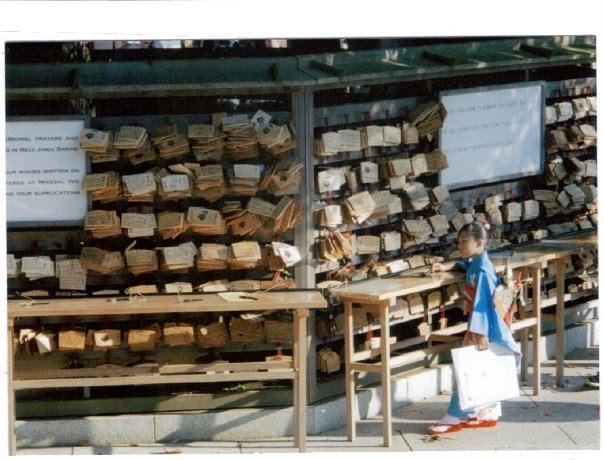
Japanese Prayer Wall

Japanese Prayer Wall

Monday, January 31, 2011

It's a small world after all

When I was younger, and not all that long ago too, I didn’t really care much for the news.  It was all a bunch of people arguing over politics and one depressing story after another about natural disasters, wars, and heinous crimes.  That description still suits the news today, but over time my perception has changed. 

I first moved to Japan just after graduating from college and was surprised by how much people in Japan knew about American politics.  More than once people assumed that because I was American, I must agree with all of President George W. Bush’s opinions.  I quickly realized that I needed to polish up on my political knowledge if for no other reason than to knowledgeably say that I agreed or disagreed with President Bush’s latest political views.  Fast forward a few years, and here I am in Japan again, trying to agree or disagree with a different president.  Thankfully there’s more to the news than just politics or else I’d quickly grow tired of trying to stay focused.

Unfortunately, many people only care about what is happening in their own city, state, and country; that is where their concern stops.  Living in another country and traveling to other countries helps me to see the people of the world as real, living and breathing individuals.  Now when I watch or read about the news, I find it harder to turn my back on the suffering of earthquake victims, human trafficking hostages, or martyrs.  Those are brothers, sisters, mothers, and fathers, not just statistics.  So, what are we supposed to do with all the pain and suffering that is happening in the world?  For starters, you can try to do what I do—pray your way through the news.  Don’t just learn about a horrific situation and the next minute return to your favorite T.V. show or your previously scheduled life.  Turn that concern over to God but also ask him if there is some kind of action that He is calling you to take.  Why not start today with the current situation in Egypt?  Instead of viewing the country as a whole, you can start by praying for my friends Stephanie and Paul Schick who are living in Cairo right now because Paul is doing his pastoral internship there.  Or, you can pray for the family of Maria, a former student, who has family living in Egypt.

One of my favorite scenes in the book Christy, by Catherine Marshall, is when Alice Henderson explains the importance of letting God pry our hands away from our eyes.  We can choose to go through life by covering our eyes to the pain and hardships all around us, or we can allow God to open our eyes so that we can see the people and the world around us the way that He does.  Although Christy is fiction, Alice is exposed to extreme hardships and suffering which reveal universal truths.  Alice says, “You want to know why seeing stark evil hasn't made me rough or bitter? Remember, I said it was God who was prying the little girl's hands off her eyes. As if He were saying, 'I can't use ivory-tower followers. They're plaster of Paris, they crumble and fall apart in life's press. So you've got to see life the way it really is before you can do anything about evil. You cannot vanquish it. I can. But in My world the battle against evil has to be a joint endeavor. You and Me. I, God, in you, can have the victory every time’” (Marshall).

Tuesday, January 18, 2011

The Outsiders

Recently I read two very interesting articles in The Japan Times about what it’s like living as a foreigner in Japan.  A person doesn’t have to live in Japan for long before learning to identify him or herself as a がいじん (gaijin or literally translated as “outsider”).  That’s when the questions really start rising.  How do you identify yourself?  How do you feel about being viewed as an “outsider”?  Have you experienced what it is like being in the minority before?  What makes you unique, and in what ways do you reinforce stereotypes about people from your country?  What do you want to hold on to in your existing identity, and what parts of a new culture do you want to embrace?  Every person answers these questions differently. 

The first article sought to show how three famous foreign men dealt with the challenges of living in Japan as outsiders.  While they shared some interesting insights, I think the real problem arose in expecting three people to represent all foreigners living in Japan.  Foreigners face unique adjustments, when moving to Japan, based on what similarities and differences exist between the Japanese culture and their own culture.  For example, at different points in history, Japan and China or Japan and Korea have strongly resented one another.  These politically based tensions may contribute to stereotypes or discrimination that other foreigners would not experience.  Likewise, men and women would naturally respond in different ways to a new culture, yet this article focused only on interviewing men.  I certainly do not agree with everything in this first article, but if you have the time, it is well worth it to see what insights and conclusions one could draw about foreigners living in Japan.
The second article was a series of comments people made as they agreed or disagreed with the first article.  Many people feel passionate about what it means to be a がいじん because, as I pointed out, every person responds differently to those difficult identity questions.  One idea that really stood out to me is the way people are so quick to judge other cultures, without examining their own culture through the same magnifying glass.  For example, in America we see people who are labeled as terrorists based on where they were born or people getting paid next to nothing for doing demanding physical work that many people would try their noses up at.  As we recently celebrated Martin Luther King, Jr. Day, can we honestly say that America is free of discrimination and that we are innocent of giving labels to identify others as outsiders?  Another point that made me smile was the comment, “Too many foreign residents make themselves miserable with constant complaints.  If I wanted everything to be as it was back home, I would have stayed there.”  I admit that I have been guilty of complaining about cultural differences at times, but when all is said and done, I am thankful for my many opportunities to learn about the Japanese culture.  As I meet and befriend people in Japan, I am also happy to point out that just like all foreigners have differences, Japanese people are unique in their own ways too.  So, for anyone who seeks to experience a new culture, the best plan is to stay open-minded about the individuals you meet as well as about yourself  as you grow and change (to varying degrees) in a new culture.  To read the many responses and comments related to the first article, you can check out the second article at this link.

Wednesday, December 22, 2010

Pictures from Ikebukuro Lutheran Church

Ikebukuro Lutheran Church

Working at the church bazaar in October with Rume

Church Bazaar

Christmas at church--a beautiful nativity scene from the Holy Land

The sanctuary

Kojima Sensei, not the pastor of this church but a retired pastor I knew from Kumamoto.

Cabbage soup (recipe from Finland) served at the Christmas Party

Church Christmas Party

Sunday, December 19, 2010

Reflections on the Hiroshima Peace Memorial Museum

Last weekend I visited the Hiroshima Peace Memorial Museum.  It was an intense and moving experience that is difficult to describe to people who haven’t been there.  It certainly feels uncomfortable on so many levels to view the horrors of atomic weapons as an American living in Japan.  One thing that I especially appreciate about this museum, though, is its emphasis on moving toward the disarmament of all atomic weapons rather than focusing on placing blame for the atomic bomb that America dropped on Hiroshima on August 6, 1945.  After visiting the museum, I went to the Peace Park to be alone and process all that I had seen.  In an attempt to share my experience with you and others, I felt compelled to do something extremely rare—write a poem.  I do not claim to be an expert writer, so please be kind as you read my poetry, where I reflect on this horrific event.


ONE MOMENT CHANGES ALL
By Christine Eige

A flash of light and a booming noise—
Heat and radiation devouring all in its way.
Flesh and clothes melting into one,
parched throats gasping for air,
seeking relief, but instead, finding black rain.
Radiation running rampant through bodies,
vital organs failing one after another,
and so many beyond recovery or care.
A whole world turned upside down,
yet the suffering only just beginning.

“Papa, please help me!
Make the pain go away.
Where are you?
I need you.
Don’t leave me this way.
Where are my little sister, my mama, and friends?
What happened to my home?
When will the nightmares finally end?”

God looks down from heaven,
his heart broken in two.
Jesus opens his arms wide saying,
“Forgive them, Father,
for they know not what they do.”

Tuesday, December 14, 2010

Linus Sharing Words of Wisdom in A Charlie Brown Christmas

http://www.youtube.com/watch?v=DKk9rv2hUfA

You Say Goodbye, and I Say Hello

Recently someone asked what was special about 2010 in my life.  I’d say that this was a year of moving and big changes. 

I started the year teaching junior and senior English classes in Decatur, Illinois.  Even though I only lived there for a year, I met some amazing and inspiring people.  I learned so much from my students, my co-workers, my friends, and my experiences there.  I am so blessed to have friends there who are still praying for me as I serve and live in Japan.

In June I moved back to Iowa to live with my parents for a few months.  A few days after we moved my things, we moved my parents out of the only home I ever remember growing up in.  It’s still weird thinking about another family living there, but I hope they will be as happy in that home as I was.  My parents moved into a condominium for people 55 and older, so that was my home for a few months too.  I didn’t realize that I was such a rebel until I tried to dry some laundry on the balcony, but the residents quickly made a rule against that.  My summer gave me a great opportunity to spend time with friends and family before my next move.

At the end of September I made the move back to Japan.  The first time I moved to Tokyo was back in 2004 when I was right out of college, and being here again shows me how much I’ve grown and changed as a person since then.  What’s neat is that after getting together with some friends here, they can see some of those positive changes in me too.  It still seems a bit weird to go from being a teacher to being a student again, but I’m grateful for the opportunity to study Japanese.  People here are so kind and welcoming, and I am enjoying this time of studying, forming friendships, and serving in what ways I can.  In March I will be moving again, this time to Kumamoto, Japan, to teach junior high and high school English.

To be honest, I don’t really like moving, and would much rather be able to settle into a community to get rooted.  So, why do I keep moving?  Whenever I make big life decisions, I cover those decisions in prayer and truly desire to follow God’s will.  Some time ago I told God that I wanted to serve him and that I was willing to go wherever he’d send me.  I meant it when I said that and still do, so that seems to mean a lot of changes and adjustments for me, at least during 2010.  The best part is that wherever I go, God goes before me and prepares the way.  Even as I start thinking about my next move, I know that God will help me through the transition and has called me there for a reason.  I can’t wait to see what adventures and opportunities await me in 2011!


P.S. Please make sure to really enjoy time with your family this holiday season.  It is a luxury that people serving in the military and people serving as missionaries abroad don’t always get to enjoy.

Tuesday, December 7, 2010

Traditional Japanese Fairy Tales

I have always been a big fan of story time and fairy tales.  Even when I took a children’s literature course in college, I was one of the first people on the floor for story time.  I think that whatever age a person is, they should enjoy an occasional bedtime story. 

Beyond merely entertainment, fairy tales can say a lot about a culture.  Think of your favorite fairy tales and the lessons that they teach.  There’s Rupunzel whose mother covets her neighbor’s cabbage, there’s Little Red Riding Hood who talks to strangers, and those poor three little pigs who more often than not are too lazy to make proper plans for the future.  Hopefully, we’ve heard these stories from a young age and are avoiding such catastrophes.  My guess is that even though these particular stories have European roots, most Americans are familiar with them.

Other cultures tell different tales but also try to prevent their youth from going down the wrong moral path.  I’ve read several traditional Japanese tales, and they seem to emphasize the virtues of respecting the elderly, obeying one’s parents, and the importance of treating others well.  Below you’ll find links to a few of my favorites.  Enjoy your bedtimes stories!

Urashima Taro:

The Toothpick Warriors:

The Spider Weaver: