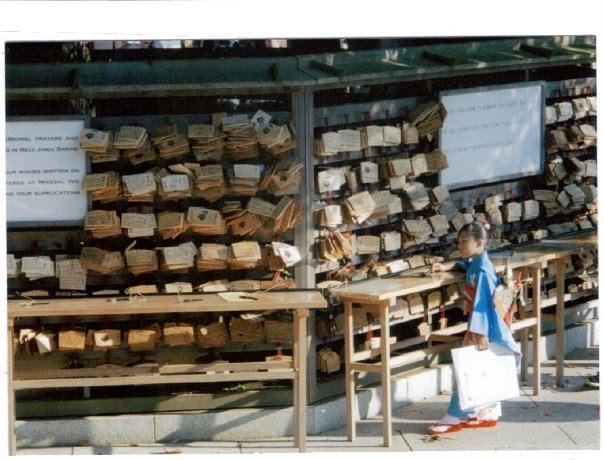
Japanese Prayer Wall

Japanese Prayer Wall

Friday, April 29, 2011

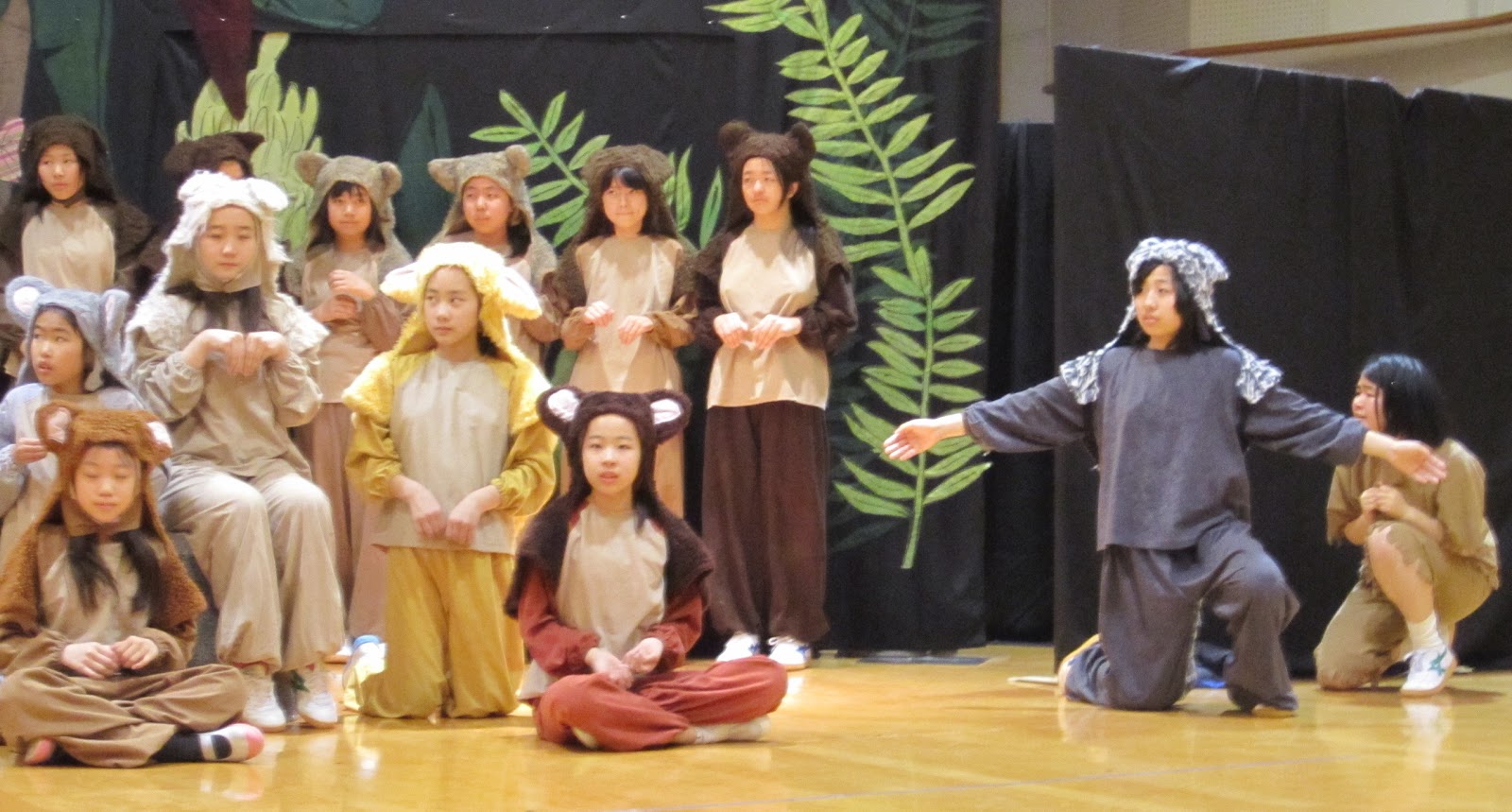
Missoula Children's Theatre and Kyu Gaku Present The Jungle Book

The entire cast of elementary and junior high students

One of my junior high students as Darzee

One of my junior high students as Shere Kan

The wolf pack with Mowgli
Three cute little monkeys

Friday, April 8, 2011

Flashbacks to Reading Rainbow

I've been in Japan for a little over 6 months now, but that makes three years total when adding it together with my last experience in Japan.  Wow, I still feel like I'm living in a dream sometimes.  I definitely think that my Japanese should be better than it is by this point, but that's something I am still working on.

Anyway, I just came across something that I wrote when I was in Japan in 2006 and felt like it was worth reposting...


As part of my Japanese experience, I try to read books related to Japan and watch some Japanese movies.  I thought I would pass along some of these recommendations in case you would also like to learn a little about Japan or the Japanese culture.  These are in no particular order, and I highly recommend all of them.

Books…

Kira Kira—by Cynthia Kadohata (Great choice for children or the young at heart)
This book recently earned the Newbery Honor award for children’s literature, and I can understand why.  It is about a Japanese family that lives in America and the challenges that they encounter.  The main character is Katie, a kindergarten girl, who has many interesting adventures and experiences with her sister (Lynn).  Kira Kira means sparkling or glittering in Japanese, and that emphasizes Lynn’s optimistic outlook on life.  It’s great but definitely a fast read.  I recommend checking this one out from the library.

The Golden Country—by Shusaku Endo
This was written by a famous Japanese Christian.  It is set in 1633 when Christians were being persecuted and killed for their outlawed beliefs.  It gives a very honest and powerful glimpse into the hardships that early Christians faced in Japan.  This book is a bit deeper and has a more serious tone but is worth reading.  This story is written in the format of a play, which some people find a little distracting.  Another option is to read the novel Silence by the same author.  Silence is an extended form of a similar story about Christian martyrdom in Japan.  I have not read Silence but hope to do that some day.

Memoirs of a Geisha—by Arthur Golden
This novel gives an amazing glimpse into a somewhat secretive part of the Japanese culture.  Geisha are girls who are highly trained in entertaining guests using the traditional Japanese arts.  The novel explores one young woman’s experiences are she grows into womanhood and how the world of geisha effects every part of her life.  The movie was mostly faithful to the book, but the book was of course better.  It was one of those books that I didn’t want to put down.

Lonely Planet: Japan
If you are ever planning on traveling in Japan, I strongly recommend purchasing this travel book.  It provides detailed information about how to get to sightseeing locations, has helpful maps, and even includes a little history about places. 

Films…
I used to have some prejudices against anime because I thought they were all violent, graphic, and showed a bit too much skin.  I was wrong, and I will be the first to admit that.  I have actually taken quite a liking to films that were directed by Hayao Miyazaki.  Have an open mind, and give them a chance.  Miyazaki really seems to use amazing creativity as well as capturing human emotions.  Sometimes I forget that I am even watching a cartoon.  If you feel adventurous, try watching these films in Japanese with English subtitles.  That is what I do to study Japanese.

Spirited Away  (PG)
Chihiro is a 10-year-old girl who finds herself trapped in a world of fantasy where anything could happen.  She is forced to work in a bath house in the hopes of discovering a way to free her parents, who were turned into pigs.  Anything can happen in this new world of magic, and the only way out is for Chihiro to remember her true identity.

I have watched several Miyazaki films now, and this is my personal ranking of them, including the Japanese title.
  1. Spirited Away/ Sen To Chihiro No Kamikakushi
  2. My Neighbor Totoro/ Tonari No Totoro
  3. Kiki’s Delivery Service/ Majo  No Takkyubin
  4. Howl’s Moving Castle/ Hauru No Ugoku Shiro
  5. Castle in the Sky/ Tenku No Shiro Rapyuta
  6. Whispers of the Heart/ Mimi Wo Sumaseba
  7. Nausicca of the Valley of the Winds/ Kaze No Tani No Naushika
  8. Porco Roso/  Kurenai No Buta
  9. Princess Mononoke/ Mononoke-hime

Shall We Dance? (PG)(not anime)
This was a Japanese comedy before it was redone in America.  The remake was pretty good, but I prefer the Japanese version.  It captures some interesting aspects of the Japanese culture and shows some exquisite dancing.  This movie shows how one man transforms from being a tired office worker to an energetic and talented ballroom dancer.  This movie is in Japanese with English subtitles.

I really enjoyed all of these books and films.  I hope that you visit your local library or video rental store, but you don’t have to take my word for it….

Friday, March 11, 2011

Japan's Earthquake and Tsunami

Yesterday afternoon the movers came to pick up my boxes and suitcases for my move to Kumamoto.  I was so impressed by the efficiency and warm customer service that I see time and time again in Japan.  Cindy helped with translating and keeping us organized, so we quickly finished.

Then, Cindy, Allyson, Ally, and I decided to visit a local restaurant.  We made it about a block away from home when the earthquake started at 2:46 p.m.  The four of us stopped in place as residents nearby left their homes to stand away from possible falling structures.  The power lines above us shook, so we backed away from the electric pole next to us.  The shaking continued for about two minutes while we huddled together in groups.  People commented on how strong the earthquake felt and how they’d never felt anything quite like it.  Actually, Japan has never had an earthquake this strong in recorded history.  As the shaking slowed down, the aftershocks continued off and on, and it was like we had just left a ship but couldn’t quite get our landlegs back.  We parted from neighbors with comments of “take care” and continued to the restaurant.  While there, rather large aftershocks continued, so everyone sought shelter under tables.  The restaurants could only sell limited items since it wasn’t safe to use the gas so soon after a big earthquake, but most people there seemed relieved to have friends or family nearby and didn’t care.  At this point we had no idea about the tsunami or the magnitude of destruction that it left in its path.  Meanwhile, the trains all over Tokyo stopped running so that thorough inspections could be done to ensure everyone’s safety. The trains, subways, and bullet trains throughout the eastern side of Honshu remained stationary for the remainder of the day, leaving millions of people stranded at work or school overnight.   

It wasn’t until I returned home and turned on the news that I started to understand the damage that the earthquake and tsunami did.  Hundreds of people lost their lives, and that number continues to grow.  Many were injured, lost their homes, or were without power on a cold night.  It’s hard to turn away from the images on the news, even though about the only Japanese word that I can understand in the reports is じしん (jishin, meaning earthquake). 

Because the movers had taken away almost everything, I didn’t even have cooking supplies or eating utensils, let alone food in the refrigerator.  Cindy, Allyson, Ally, and I ventured out to a nearby grocery store only to find the lights off and the doors closed.  The clerk at the 7-11 next door told us that the merchandise fell off the shelves during the earthquake, so the store was forced to close.  The shelves at 7-11 were pretty bare, but we managed to stock up on some water and cups of noodle.

Ally, Allyson, and Cindy at the nearly empty convenience store.

Throughout the night the tremors continued off and on, but I feel guilty even mentioning my lack of sleep when I think about all the people who are struggling with much bigger problems right now.  Especially for those communities closest to the tsunami, the challenges are just beginning.  While other people may return to their normal lives, they face the loss of friends and family, homes, and all their possessions.  My heart and prayers go out to the people of Japan right now who are in the midst of this turmoil and tragedy.  Please pray for them not only today, but in the weeks and months ahead as they try to rebuild their lives.

Picture of the tsunami taken from the Associated Press website

Wednesday, March 2, 2011

The Times They Are A-Changin'

It’s that time again…moving time! 

Last week I received my official job placement.  The Japan Evangelical Lutheran Church pastors and higher-ups meet once a year to make decisions about where to place seminary graduates and new missionaries.  For the next two years I will teach English at Kyushu Gakuin in Kumamoto (that’s on the southern island of Japan).  I will teach English to kindergarten, junior high, and high school students at a private Lutheran school.  Religious schools in Japan are a bit different from the States though.  In America, generally students go to religious schools because their family is Christian, and the parents want those values instilled in their children.  In Japan, many students and staff working at the schools are not Christian, but they choose the schools based on their reputations for strong education programs.  The churches and Christian schools view this as an opportunity to introduce students to Christianity, and this is usually done through daily chapel services, religion classes, and staff members who are Christians.  I am looking forward to giving chapel speeches and openly share my faith as opportunities arise. In a country where less than 1 % is Christian, I am thankful that I can share my faith through my daily interactions with others in words and actions.

This is my last week of intensive Japanese language training, but I will continue studying Japanese once I arrive in Kumamoto.  I still have times when I get frustrated over not having the vocabulary to say what I really want to say, but I can also see that I have made significant progress in my language skills.  I hope and pray that I can continue improving my Japanese in the years ahead and use those skills to assist me in forming meaningful relationships.

Currently I’m having mixed feelings about moving.  On the one hand, it will be hard to leave the people and places that I’ve come to love in the Tokyo area.  On the other hand, I am definitely looking forward to meeting my new students, co-workers, church members, and friends.  This is my fourth move since June, and the moving process and transition time is not something that I enjoy.  Please keep me in your prayers during this time of transitions as one chapter ends and a new one begins.

Ally, Allyson, and Me on Placement Day

Saturday, February 12, 2011

Megumi

Recently I did a little calligraphy during one of my Japanese classes.  The Japanese style requires a paintbrush and black paint rather than a pen with a slanted tip, like the Western style.  I really wanted to do my best so that I could turn my calligraphy into a beautiful wall hanging, but I’ve only done this style one other time, and it is really difficult.  As I practiced, many times I wished that I had a delete or undo button; one small mistake could mess up the whole picture, and that really started stressing me out.  I would start out fine but inevitably make a mistake, get even more frustrated, and then make more mistakes.  Finally, I paused long enough to examine the word in front of me: megumi (grace).  Then the light bulb above my head suddenly lit up.  I was trying so hard to do my calligraphy perfectly, but that’s not how grace works.  Grace is God’s free gift of forgiveness that is not based on anything we do.  God looks at our mistakes and says, “Of course you can have another chance; Jesus died to take away those sins and mistakes of your past.” 


Monday, January 31, 2011

It's a small world after all

When I was younger, and not all that long ago too, I didn’t really care much for the news.  It was all a bunch of people arguing over politics and one depressing story after another about natural disasters, wars, and heinous crimes.  That description still suits the news today, but over time my perception has changed. 

I first moved to Japan just after graduating from college and was surprised by how much people in Japan knew about American politics.  More than once people assumed that because I was American, I must agree with all of President George W. Bush’s opinions.  I quickly realized that I needed to polish up on my political knowledge if for no other reason than to knowledgeably say that I agreed or disagreed with President Bush’s latest political views.  Fast forward a few years, and here I am in Japan again, trying to agree or disagree with a different president.  Thankfully there’s more to the news than just politics or else I’d quickly grow tired of trying to stay focused.

Unfortunately, many people only care about what is happening in their own city, state, and country; that is where their concern stops.  Living in another country and traveling to other countries helps me to see the people of the world as real, living and breathing individuals.  Now when I watch or read about the news, I find it harder to turn my back on the suffering of earthquake victims, human trafficking hostages, or martyrs.  Those are brothers, sisters, mothers, and fathers, not just statistics.  So, what are we supposed to do with all the pain and suffering that is happening in the world?  For starters, you can try to do what I do—pray your way through the news.  Don’t just learn about a horrific situation and the next minute return to your favorite T.V. show or your previously scheduled life.  Turn that concern over to God but also ask him if there is some kind of action that He is calling you to take.  Why not start today with the current situation in Egypt?  Instead of viewing the country as a whole, you can start by praying for my friends Stephanie and Paul Schick who are living in Cairo right now because Paul is doing his pastoral internship there.  Or, you can pray for the family of Maria, a former student, who has family living in Egypt.

One of my favorite scenes in the book Christy, by Catherine Marshall, is when Alice Henderson explains the importance of letting God pry our hands away from our eyes.  We can choose to go through life by covering our eyes to the pain and hardships all around us, or we can allow God to open our eyes so that we can see the people and the world around us the way that He does.  Although Christy is fiction, Alice is exposed to extreme hardships and suffering which reveal universal truths.  Alice says, “You want to know why seeing stark evil hasn't made me rough or bitter? Remember, I said it was God who was prying the little girl's hands off her eyes. As if He were saying, 'I can't use ivory-tower followers. They're plaster of Paris, they crumble and fall apart in life's press. So you've got to see life the way it really is before you can do anything about evil. You cannot vanquish it. I can. But in My world the battle against evil has to be a joint endeavor. You and Me. I, God, in you, can have the victory every time’” (Marshall).

Tuesday, January 18, 2011

The Outsiders

Recently I read two very interesting articles in The Japan Times about what it’s like living as a foreigner in Japan.  A person doesn’t have to live in Japan for long before learning to identify him or herself as a がいじん (gaijin or literally translated as “outsider”).  That’s when the questions really start rising.  How do you identify yourself?  How do you feel about being viewed as an “outsider”?  Have you experienced what it is like being in the minority before?  What makes you unique, and in what ways do you reinforce stereotypes about people from your country?  What do you want to hold on to in your existing identity, and what parts of a new culture do you want to embrace?  Every person answers these questions differently. 

The first article sought to show how three famous foreign men dealt with the challenges of living in Japan as outsiders.  While they shared some interesting insights, I think the real problem arose in expecting three people to represent all foreigners living in Japan.  Foreigners face unique adjustments, when moving to Japan, based on what similarities and differences exist between the Japanese culture and their own culture.  For example, at different points in history, Japan and China or Japan and Korea have strongly resented one another.  These politically based tensions may contribute to stereotypes or discrimination that other foreigners would not experience.  Likewise, men and women would naturally respond in different ways to a new culture, yet this article focused only on interviewing men.  I certainly do not agree with everything in this first article, but if you have the time, it is well worth it to see what insights and conclusions one could draw about foreigners living in Japan.
The second article was a series of comments people made as they agreed or disagreed with the first article.  Many people feel passionate about what it means to be a がいじん because, as I pointed out, every person responds differently to those difficult identity questions.  One idea that really stood out to me is the way people are so quick to judge other cultures, without examining their own culture through the same magnifying glass.  For example, in America we see people who are labeled as terrorists based on where they were born or people getting paid next to nothing for doing demanding physical work that many people would try their noses up at.  As we recently celebrated Martin Luther King, Jr. Day, can we honestly say that America is free of discrimination and that we are innocent of giving labels to identify others as outsiders?  Another point that made me smile was the comment, “Too many foreign residents make themselves miserable with constant complaints.  If I wanted everything to be as it was back home, I would have stayed there.”  I admit that I have been guilty of complaining about cultural differences at times, but when all is said and done, I am thankful for my many opportunities to learn about the Japanese culture.  As I meet and befriend people in Japan, I am also happy to point out that just like all foreigners have differences, Japanese people are unique in their own ways too.  So, for anyone who seeks to experience a new culture, the best plan is to stay open-minded about the individuals you meet as well as about yourself  as you grow and change (to varying degrees) in a new culture.  To read the many responses and comments related to the first article, you can check out the second article at this link.